


 Alex Rommal
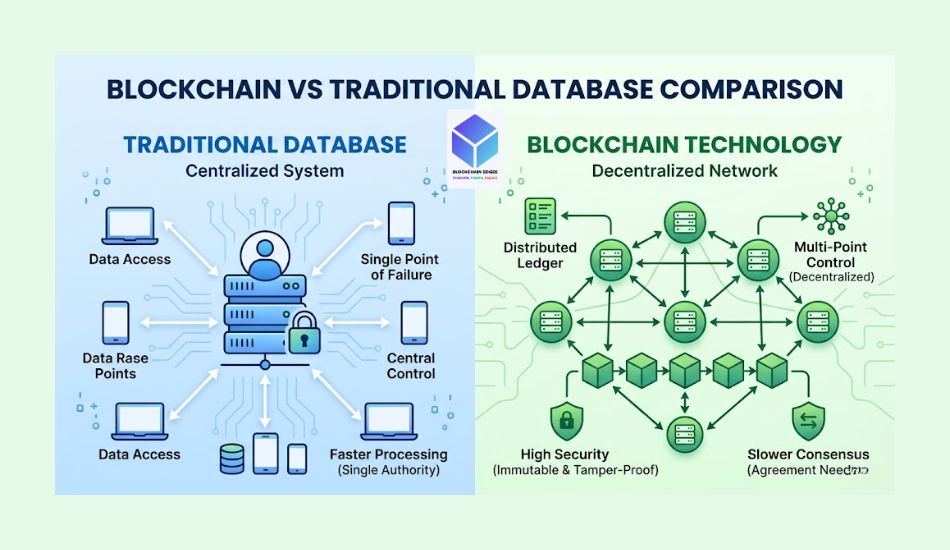
 Blockchain vs database feels confusing because both store data, but they solve very different problems. You may wonder, “Is a Blockchain just another Database?”
The short answer is no, and choosing the wrong one can cost you speed, money, and trust.
At their simplest, both are just ways to store information. However, they are built for very different purposes.
A traditional database runs on a Centralized System, where a Database Administrator controls data using CRUD and tools like SQL inside a Relational Database such as MySQL or PostgreSQL. This setup is fast and efficient, but it depends on trust and can suffer from a Single Point of Failure.
On the other side, blockchain works as a Distributed Ledger built on Decentralization. Its Blockchain Architecture stores data in a Block, secured by a Hash Function, and shared across every Node.
Each Blockchain Transaction is verified through a Consensus Mechanism like Proof of Work or Proof of Stake.
This design protects Data Integrity and ensures Immutability, giving high Transparency, but it may reduce Scalability and increase Latency.
You might also see systems such as a Distributed Database, a Centralized Database, a Private Blockchain, or a Shared Database.
Some advanced solutions, such as Amazon Web Services’ Quantum Ledger Database, aim to combine both ideas.
Real-world platforms such as Bitcoin and Ethereum use blockchain, while enterprise solutions from IBM often mix blockchain with databases.
So the real solution for you is simple: if you need speed and control, a database is the right choice. If you need shared trust and tamper-proof records, blockchain is better.
You will clearly see how to choose the right system based on your exact needs without confusion.
What Is a Database? Simple Meaning You Can Understand
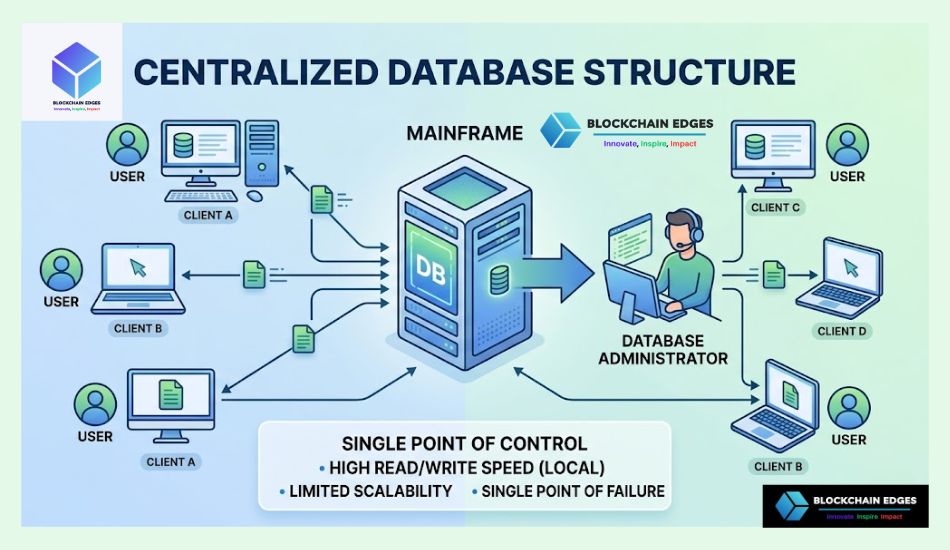
A Database is a system where you store, manage, and update data easily. You use it every day, even if you don’t see it. When you log into a website, send money, or shop online, your data is stored in a database.
Most databases work in a Centralized System. This means one company or owner controls everything. A Database Administrator decides who can see, change, or delete the data.
Very Simple: How a Database Works?
A database follows a basic process called CRUD:
- Create- You add new data
- Read- You view data
- Update– You changed the data
- Delete– You remove data
This makes databases very flexible and fast.
Structure of a Database
Most systems use a Relational Database. Data is stored in tables like rows and columns in Excel. To manage this data, you use SQL. Example tools:
- MySQL
- PostgreSQL
- Oracle Database
Why Databases Are So Fast?
Databases are designed for:
- High Scalability
- Low Latency
Because one system controls everything, decisions are quick.
The Main Limitation You Should Know
A centralized database has one big risk called a Single Point of Failure. If the main server fails or is hacked:
- The system can stop
- Data can be changed or lost
- Users must trust the owner completely
This is where blockchain starts to look different and sometimes better.
Simple Meaning: What Is Blockchain? You Can See Clearly.
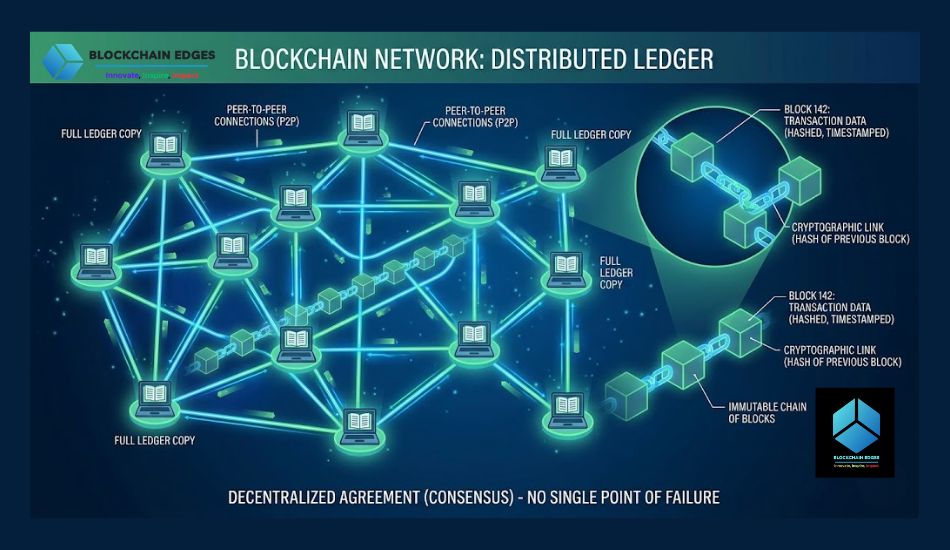
A Blockchain is a system where data is shared across many computers by one owner. It works as a Distributed Ledger, so everyone in the network has the same copy of data.
This system removes the need for a central authority by using Decentralization. That means no single person or company controls everything.
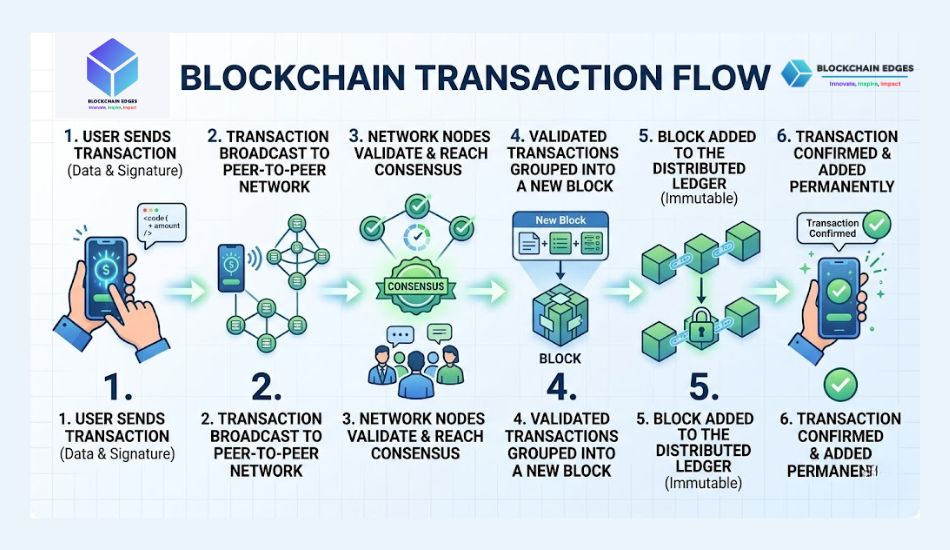
Step-by-Step: How Blockchain Works?
Blockchain follows a very clear process:
- You send data called a Blockchain Transaction
- The network checks it using a Consensus Mechanism
- The data is grouped into a Block
- The block is secured with a Hash Function
- The block is added to the chain and shared with every Node
Why is Blockchain Hard to Change?
Once data is added, it becomes permanent. This is called:
- Immutability
- Strong Data Integrity
No one can easily edit or delete their past records.
How Transactions Get Approved?
Blockchain uses special rules called consensus:
- Proof of Work used by Bitcoin
- Proof of Stake used by Ethereum
These methods make sure all participants agree before data is added.
What Makes Blockchain Different for You?
Blockchain gives you:
- High Transparency
- No central control (no single failure point)
- Shared trust between users
But there is a trade-off:
- Lower Scalability
- Higher Latency
Blockchain vs Database: Side-by-Side Comparison That Clears Your Confusion.
Struggling to understand blockchain vs traditional database? This Guide Helps. Now you have a clear idea of both systems. Let’s compare them directly so you can see the real difference without confusion.
1. Simple Core Difference in One Line You Can Understand Fast.
A Database depends on a Centralized System, while a Blockchain runs on Decentralization.
| Feature | Database | Blockchain |
| Control | One owner (admin) | Shared across the network |
| System Type | Centralized Database | Distributed Ledger |
| Data Handling | Uses CRUD | Append-only (no delete) |
| Structure | Relational Database | Blockchain Architecture |
| Query System | SQL | No traditional query system |
| Trust Model | Trust the owner | Trust the system (rules) |
| Data Security | Editable | Immutability |
| Risk | Single Point of Failure | No single failure point |
| Speed | High | Lower due to Consensus Mechanism |
| Transparency | Limited | High Transparency |
2. What This Means for You: Very Important
- If you want full control and fast updates, a database is better
- If you want shared trust and tamper-proof records, blockchain is better
3. The Truth Most People Miss
A Distributed Database is NOT the same as blockchain.
- A distributed database still controlled by one authority
- Blockchain has no central control at all
This is where most confusion happens.
Real Example
- Your bank uses a fast, controlled, and editable database.
- Bitcoin uses a shared, secure, and permanent blockchain.
Blockchain vs SQL: Are They the Same or Not?
A clear answer to a common confusion. You may search “blockchain vs SQL” and feel even more confused. The truth is simple: you are comparing two very different things.
SQL is not a system. It is a language used to manage a Database, especially a Relational Database.
But a Blockchain is a full system built on Blockchain Architecture.
1. Simple Difference: SQL VS Blockchain
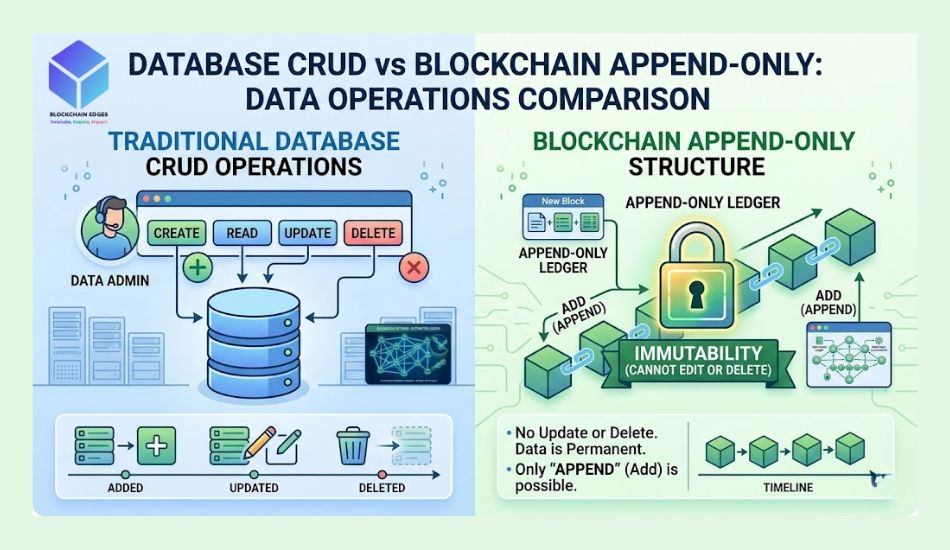
- SQL is used to query and change data
- Blockchain is used to store data permanently
2. How SQL Works Easy View?
With SQL, you can:
- Read data
- Update data
- Delete data
- Control everything using CRUD
Example: You can change a user’s name at any time.
3. How Blockchain Handles Data?
Blockchain does NOT allow free editing.
- You can only add a new Blockchain Transaction
- Data is locked using a Hash Function
- Every update must pass a Consensus Mechanism
You cannot simply delete or edit past records.
4. Key Difference Blockchain VS SQL Matters to You
| Feature | SQL Database | Blockchain |
| Control | Full control | Shared control |
| Data Editing | Easy | Almost impossible |
| Speed | Fast | Slower |
| Trust | Owner-based | System-based |
Real-Life Example:
- Apps using MySQL fast updates, flexible
- Networks like Ethereum secure, permanent records
Important Insight
If your system needs:
- Frequent updates use a SQL database
- Permanent, trusted records use blockchain
Blockchain VS Centralized Database: Where Trust Really Changes?
This is the part where most confusion happens. You are not just comparing tools, but comparing control and trust, models.
A Centralized Database is managed by one authority. A company, admin, or organization fully controls a Database inside this system.
In contrast, a Blockchain removes single control and works through Decentralization, where many computers share responsibility.
1. Blockchain VS Centralized Database: A Simple Difference
- Centralized database, one owner controls everything
- Blockchain is no single owner controls everything
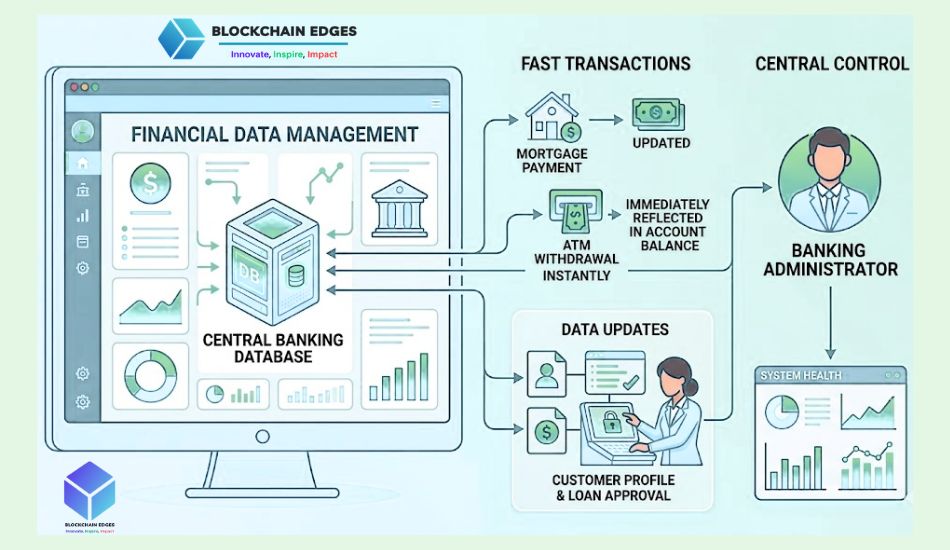
2. How Centralized Databases Work?
In a centralized system:
- A Database Administrator manages data
- Data changes using CRUD
- Systems often use SQL
- Data is stored in a Relational Database
Example systems:
- MySQL
- Oracle Database
3. How Blockchain Differs?
Blockchain works in a shared network:
- Data is stored in a Distributed Ledger
- Each update is a Blockchain Transaction
- Verified using a Consensus Mechanism
- Protected by Immutability
Example: Bitcoin records transactions that cannot be changed
4. Key Trust Difference: Blockchain VS Centralized Database
| Factor | Centralized Database | Blockchain |
| Trust | Trust the company | Trust the network rules |
| Control | Single authority | Shared across nodes |
| Risk | Single Point of Failure | No single failure point |
Real Example You Understand Easily
- Bank system: a centralized database (fast, controlled, editable)
- Crypto system like Ethereum: blockchain (shared, permanent, transparent)
Simple Rule for You: If one company is fully in control, it is a centralized database.
If many participants share control, it is blockchain.
Blockchain VS Distributed Database: The Most Common Mistake
Many people think a Distributed Database is the same as a Blockchain. They sound similar, but they are not the same. Both use multiple computers, but the control and trust model is completely different.
Simple Difference: Blockchain VS Distributed Database
- Distributed database still controlled by one organization
- Blockchain: no single organization controls it (Decentralization)
How Distributed Databases Work?
A distributed database:
- Spreads data across many servers
- Still managed by one authority
- Uses a Centralized System logic behind the scenes
- Can still be changed or deleted by admins using CRUD
It improves speed and reliability, but trust is still central.
How is Blockchain Different?
Blockchain also spreads data across many computers, but:
- Data is stored in a Distributed Ledger
- Each record is a Blockchain Transaction
- Changes are verified by a Consensus Mechanism
- Data becomes permanent due to Immutability
Key Difference Blockchain VS Distributed Database
| Feature | Distributed Database | Blockchain |
| Control | One organization | No single owner |
| Trust | Central authority | Network agreement |
| Data Change | Allowed | Almost impossible |
| Purpose | Performance & scaling | Trust & transparency |
- MySQL cluster distributed database (fast, controlled)
- Bitcoin blockchain (transparent, tamper-proof)
Real Example:
The Key Mistake You Should Avoid
Just because a system uses multiple servers does NOT mean it is blockchain.
- If one company still controls it is a distributed database
- If no one fully controls it is a blockchain
Simple Rule for You:
- Want speed and control of a distributed database
- Want trust without a middle authority, blockchain
Real-World Use Cases: When You Should Choose Each One
Now you understand the differences. The next step is simple: when should you use a database, and when should you use blockchain? This is where your confusion turns into a clear decision.
When You Should Use a Database
Choose a Database when you need:
- Fast performance (low Latency)
- High Scalability
- Full control over data
- Easy updates using CRUD
Real examples you use every day:
- Banking apps (account updates, transactions)
- Social media platforms
- E-commerce websites
Common tools:
- MySQL
- PostgreSQL
When You Should Use Blockchain
Choose Blockchain when you need:
- Shared trust between multiple parties
- Strong Data Integrity
- Permanent records with Immutability
- No central authority (Decentralization)
Real-world use cases:
- Cryptocurrencies like Bitcoin
- Smart contracts on Ethereum
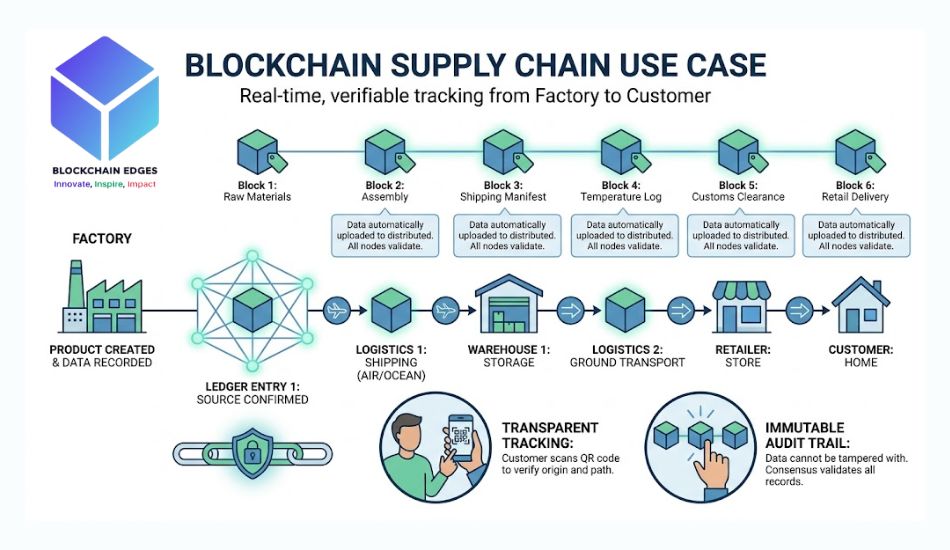
- Supply chain tracking
- Digital identity systems
When You Need Both Hybrid Solution
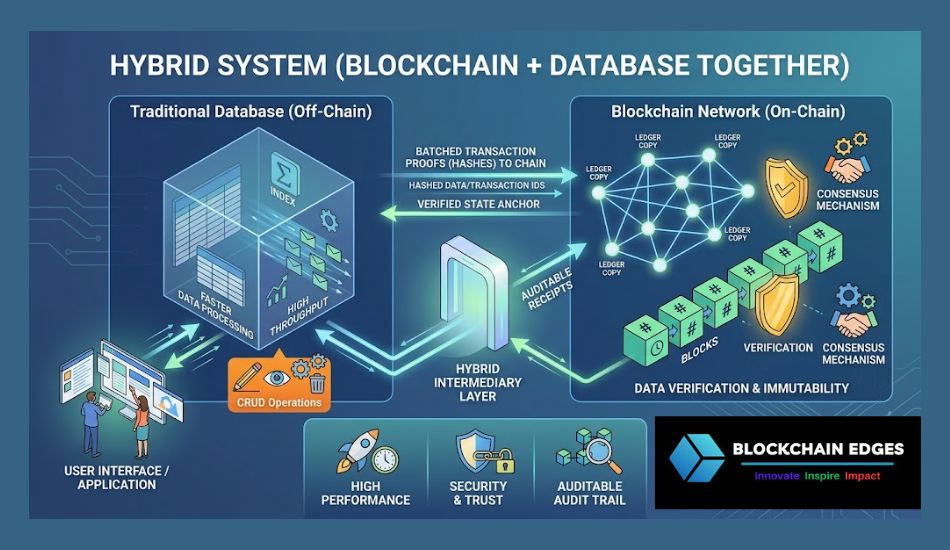
Sometimes, you need speed and trust. This is where hybrid systems come in:
- Use a database for fast processing
- Use blockchain for final verification
Example:
- Quantum Ledger Database by Amazon Web Services
- Enterprise solutions from IBM
Simple Decision Guide for You
Ask yourself:
- Do you trust one owner? Use a database
- Do you NOT trust a single owner? Use blockchain
- Do you need both speed and trust? Use hybrid
However, you don’t need blockchain for everything. And you don’t need a database for trust problems. The right choice depends on your real problem.
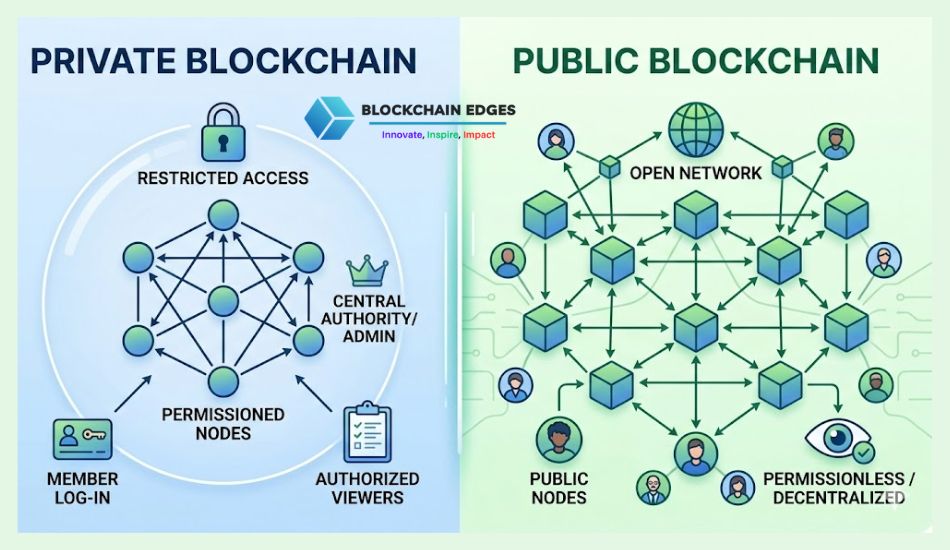
Pros and Cons of Blockchain vs Database Explained Like You’re New to Tech.
Stop mixing up blockchain and databases. Get to know the key difference fast. Now you need one thing with a clear, honest view of the pros and cons. This helps you avoid hype and choose what actually works for your situation.
Blockchain vs Database: Key Differences
| Feature | Blockchain | Traditional Database |
| Control | No single owner (decentralized) | One owner or company (centralized) |
| Data Storage | Stored in blocks linked in a chain | Stored in tables, rows, or documents |
| Examples | Bitcoin, Ethereum | MySQL, MongoDB |
| Data Editing | Cannot change or delete (immutable) | Can update, edit, or delete anytime |
| Speed | Slower (needs network approval) | Faster (controlled by one system) |
| Trust | Trust comes from code and network rules | Trust comes from the owner or admin |
| Security | Very strong (uses Cryptography) | Strong, but depends on the system setup |
| Transparency | Public and open (anyone can see data) | Private or limited access |
| Use Cases | Crypto, smart contracts, digital assets | Apps, banking systems, websites |
| Data Structure | Linked blocks with a hash | Tables using SQL or a flexible NoSQL format |
Very Simple: Use blockchain when you do not want to trust one person or company. Use a database when you need speed, control, and easy updates.
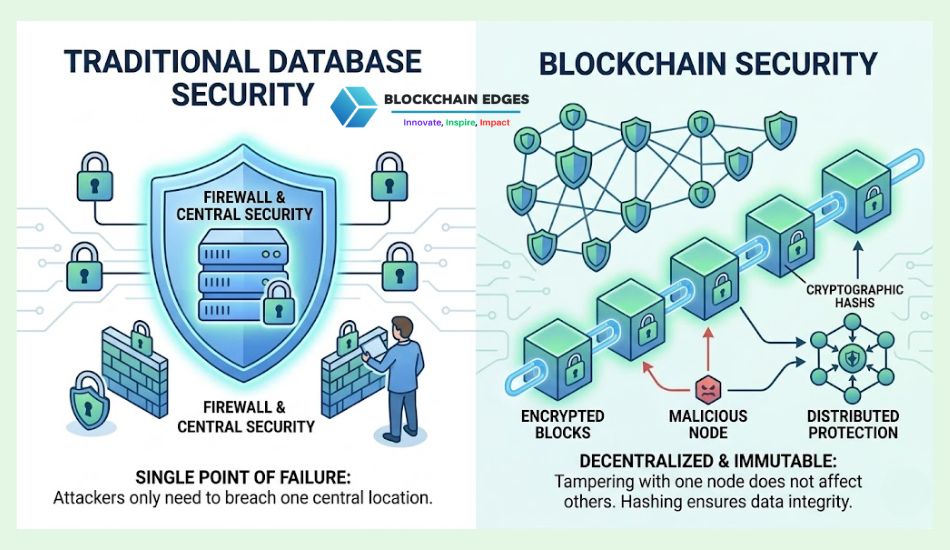
Conclusion About Blockchain vs Relational Database: What Makes Them Unique?
Blockchain vs database is not about which one is better. You now see the truth clearly. It is about what problem you are trying to solve.
If you feel stuck because you do not trust systems, or you worry someone can change your data, then blockchain gives you a strong answer.
Networks like Bitcoin and Ethereum show how people can share data without needing a central owner. Everything stays open, safe, and locked using Cryptography.
But if your problem is speed, easy control, and fast updates, then a traditional database is the right choice. Tools like MySQL and MongoDB help you manage apps, websites, and user data smoothly using systems like SQL.
You choose blockchain when you need trust without a middle person, want data that cannot be changed, and you are building crypto or smart systems.
As a same choose a database when you need speed and control, and want to edit or update data anytime, you are building apps, websites, or business tools.
You do not need to choose one forever. Many smart systems today mix both. They use blockchain for trust and a database for speed.
That means you can build something safe, fast, and useful at the same time. Now you know exactly what to pick, based on your real need.
Relevant article: Simple Explanation for Beginners: Can You Understand Blockchain in 5 Minutes?
FAQs: Blockchain vs Database Distributed: Which One Fits Your Project?
1. Is blockchain a database?
You can think of blockchain as a special kind of database, but it is not the same. A traditional database lets you edit or delete data anytime. A blockchain stores data in a distributed ledger that cannot be changed once added. That makes it more secure, but less flexible.
2. What is the main difference between blockchain and a database?
The biggest difference is control and trust. A centralized database is managed by one owner or database administrator. But blockchain works on a decentralized system, where no single person controls everything.
3. How are new transactions added to the blockchain?
New data is added through a process called the consensus mechanism. Methods like Proof of Work or Proof of Stake help verify each blockchain transaction before adding it to the chain.
4. Can blockchain replace traditional databases?
No, not always. A traditional database system is faster and better for apps like banking or social media. Blockchain is better when you need trust between many parties who do not know each other.
5. What is the difference between blockchain and SQL databases?
SQL databases like MySQL or PostgreSQL follow the CRUD model (Create, Read, Update, Delete). Blockchain is append-only. You can only add new data, not change old records.
6. What is a blockchain database example?
A simple example is the Bitcoin network. It records all transactions in a public and secure way. Another example is Ethereum, which also runs smart contracts.
7. What is a private blockchain vs a database?
A private blockchain is controlled by a group, not the public. It still keeps data secure and shared. But a normal database is still faster and easier to manage for internal use.
8. Is blockchain more secure than a database?
Blockchain is more secure for tamper-proof records because of cryptography and its distributed nature. But databases can also be very secure if managed well.
9. What is blockchain architecture?
Blockchain architecture includes blocks, nodes, and the network. Each block stores data and links to the previous one, forming a chain that cannot be broken.
10. When should you use blockchain instead of a database?
You should use blockchain when you need trust without a middleman. Many users share data that must stay permanent. Use a database when you need fast performance, when data changes often, and when one organization controls everything.
