


 Alex Rommal
 Is blockchain dead by 2026? It’s a question echoing across Reddit threads, CIO reports, and crypto communities as investors and technologists question whether the once-revolutionary blockchain technology has reached its end in 2026.
After years of volatility in cryptocurrencies like Bitcoin and Ethereum, and waves of what experts dubbed the “Blockchain Winter,” it’s easy to mistake silence for demise.
Yet beneath the fading headlines, blockchain, the distributed ledger technology (DLT) that enables decentralization, trust, and immutability, is quietly powering the next phase of the digital economy.
Today, while speculative projects collapse, enterprise blockchain adoption continues to grow across finance, supply chain management, identity verification, and even AI-driven data analytics.
Companies such as IBM, Hyperledger, and VeChain are proving that blockchain’s real strength lies not in hype but in its infrastructure, solving tangible issues such as transparency, interoperability, and secure data exchange.
According to Forbes and TechTarget, this marks a critical evolution from a buzzword associated with crypto speculation to a core enabler of Web3, AI integration, and tokenized asset systems.
So, no blockchain is dead. It’s maturing. The decentralized ecosystem is shifting from marketing slogans to measurable impact, forging partnerships among technologies such as Artificial Intelligence, the Internet of Things (IoT), and smart contracts.
For innovators, developers, and investors alike, this means the real question isn’t whether blockchain is alive but whether you’re ready for the version that’s evolving beyond the hype.
Why Do People Believe Blockchain Is Dead?
The belief that blockchain is dead didn’t appear out of nowhere; it’s the result of years of market volatility, media fatigue, and misaligned expectations.
When the cryptocurrency boom of the late 2010s and early 2020s gave rise to massive speculation around Bitcoin, Ethereum, and thousands of altcoins, investors poured billions into projects promising to “revolutionize everything.”
But as the crypto market collapsed, taking with it countless tokens, NFTs, and DeFi platforms, the public perception of blockchain took a direct hit.
Many equated blockchain’s fate with that of crypto, assuming that because prices crashed, the technology itself had failed. Add in regulatory uncertainty, high-profile scams, and overhyped initial coin offerings (ICOs), and you have a recipe for skepticism.
Reports from CIO and Splunk described this moment as the “end of the blockchain hype cycle,” where even enterprise executives began to doubt whether the decentralized ledger technology (DLT) had practical use beyond theory.
Yet much of this perception stems from misunderstanding. Blockchain wasn’t designed to make people rich overnight; it was designed to build transparent, trustless systems. The so-called Blockchain Winter wasn’t a death sentence; it was a cooling period that separated speculation from substance.
In fact, during this quieter phase, companies like IBM, Hyperledger, and Oracle doubled down on developing scalable, interoperable, and energy-efficient blockchain solutions.
So while the hype subsided, the innovation didn’t stop; it simply moved behind the scenes, where the technology continues to mature and find its most effective applications.
The Reality: Blockchain Isn’t Dead, It’s Evolving
Despite the noise around crypto collapses and fading hype cycles, the reality is clear: blockchain isn’t dead, it’s evolving into a mature layer of digital infrastructure.
While early adoption revolved around speculative assets, today’s distributed ledger technology (DLT) has become a backbone for enterprise innovation, powering transparent, secure, and efficient systems across multiple industries.
According to Deloitte’s 2024 Blockchain Survey, over 80% of global enterprises report active blockchain initiatives, with a focus on supply chain transparency, digital identity, and financial data integrity.
Giants like IBM, Oracle, and Microsoft Azure have integrated Hyperledger Fabric and enterprise blockchain platforms into business workflows, proving that the technology’s value lies in trust automation, not token speculation.
Real-world applications are thriving quietly behind the scenes. VeChain streamlines product authenticity in global logistics, Hyperledger enhances traceability in pharmaceutical supply chains, and RippleNet enables instant cross-border settlements for banks using blockchain rails. These are tangible use cases solving real problems, not speculative trends.
Even the tech stack around blockchain has matured. Interoperability between networks, energy-efficient consensus models like Proof of Stake, and AI-integrated smart contracts have made blockchain more scalable, intelligent, and sustainable than ever. As Forbes recently noted, “The next phase of blockchain isn’t about coins, it’s about connectivity.”
In short, blockchain didn’t die, it grew up. The technology has quietly transitioned from hype to utility, from buzzword to backbone. What we’re witnessing isn’t a collapse, but a correction of the natural evolution of a technology moving from experimentation to real-world adoption.
How Blockchain Is Transforming Industries?
If blockchain were truly dead, global industries wouldn’t still be quietly integrating it into their core systems.
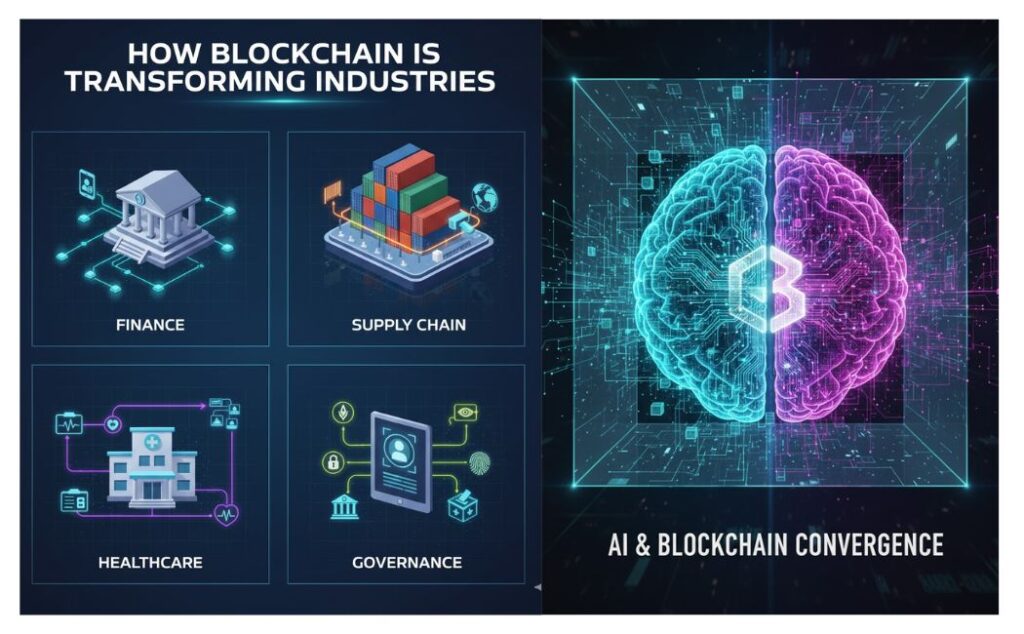
In reality, blockchain is reshaping how finance, logistics, healthcare, and even government operations handle trust, security, and verification.
The technology’s decentralized nature and cryptographic transparency make it ideal for any environment that demands data integrity and traceability.
1. Finance & Banking: From Disruption to Integration
In the financial sector, blockchain has evolved from a crypto novelty to an enterprise-grade infrastructure. Platforms like RippleNet, JP Morgan’s Onyx, and Central Bank Digital Currencies (CBDCs) are redefining cross-border payments and settlement speed. Smart contracts are automating complex financial agreements, reducing operational costs, and minimizing human error.
Even traditional players like Visa and Mastercard are exploring tokenized assets and stablecoins for near-instant transactions, proving that blockchain has become a quiet foundation of modern fintech.
2. Supply Chain & Logistics: Transparency in Motion
In logistics and manufacturing, blockchain provides end-to-end visibility. Solutions like IBM Food Trust, VeChain, and Hyperledger Fabric allow companies to trace every stage of product movement from origin to shelf, ensuring authenticity and compliance.
For example, Walmart uses blockchain to track food safety data in real time, reducing contamination risks and increasing consumer confidence.
3. Healthcare: Securing Patient Data
The healthcare industry is adopting blockchain for data interoperability and patient privacy. Networks like MedRec and Guardtime are securing medical records on decentralized ledgers, ensuring that only authorized providers can access sensitive information. This reduces data breaches while enabling more efficient, patient-centered care.
4. Digital Identity & Governance: Power to the Individual
Governments and public-sector organizations are exploring blockchain identity solutions to improve digital trust. Estonia is a global leader in blockchain-backed e-governance, enabling secure digital signatures, online voting, and citizen data protection. Blockchain-based digital identity frameworks are also being tested by the European Union and World Bank, signaling a global shift toward self-sovereign digital identities.
5. Web3 & AI Convergence: The Next Phase
The integration of AI and Web3 represents the next frontier of blockchain’s evolution. AI-driven smart contracts, decentralized data marketplaces, and blockchain-based AI model tracking are reshaping how algorithms are trained and monetized. This convergence ensures transparency in AI systems, addressing growing concerns about bias, ownership, and regulation.
Across all sectors, one pattern is clear: Is blockchain dead? It isn’t disappearing; it’s embedding itself into the digital fabric of modern infrastructure.
Challenges Blockchain Still Faces: How They’re Being Solved?
Is blockchain dead? While blockchain’s progress is undeniable, the road to mainstream adoption hasn’t been smooth. Like any transformative technology, blockchain still faces a series of technical, regulatory, and social hurdles that must be addressed before it can achieve full-scale integration. Is Blockchain Dead in 2026? Here’s the Truth No One’s Talking About;
1. Scalability and Performance
One of the earliest criticisms of blockchain has been its limited scalability. Public networks like Bitcoin and Ethereum struggle to process thousands of transactions per second, leading to congestion and high gas fees. However, the landscape is shifting fast.
Upgrades like Ethereum 2.0, sharding, and Layer 2 solutions such as Polygon, Arbitrum, and Optimism are vastly improving throughput while reducing costs.
Meanwhile, new consensus mechanisms like Proof of Stake (PoS) and Delegated Proof of Stake (DPoS) offer energy efficiency and faster block validation, marking a major step toward scalability and sustainability.
2. Regulation and Compliance
Regulatory clarity remains one of blockchain’s biggest bottlenecks. Governments worldwide are still determining how to classify digital assets, tokenized securities, and smart contracts under existing laws.
Is Blockchain Dead? Organizations like the European Union, U.S. SEC, and Financial Action Task Force (FATF) are gradually shaping frameworks to ensure consumer protection, anti-money laundering (AML) compliance, and data transparency.
Paradoxically, these evolving regulations may actually strengthen blockchain’s legitimacy by separating responsible innovation from fraud and speculation.
3. Security and Interoperability
Even with its cryptographic foundation, blockchain is not immune to smart contract bugs, bridge attacks, or private key theft.
To counter these threats, projects such as Chainlink, Cosmos, and Polkadot are pioneering interoperable, secure network architectures that enable safer cross-chain communication.
Simultaneously, advancements in zero-knowledge proofs (ZKPs) and multi-signature wallets are improving privacy and resilience against exploitation.
4. Adoption and User Experience
For most users and enterprises, blockchain still feels complex and inaccessible. Setting up wallets, managing private keys, or understanding gas fees can be overwhelming.
Modern UX innovations like custodial wallets, Web3 browsers, and gasless transactions are making blockchain apps far more user-friendly. Companies like MetaMask, Coinbase, and Ledger are leading this transformation, simplifying onboarding for the next billion users.
Despite these challenges, the blockchain ecosystem is adapting rapidly. In the same way, the internet overcame dial-up limitations and mobile networks evolved beyond 3G; blockchain is undergoing its own infrastructure renaissance. Each obstacle sparks a wave of innovation, pushing the technology closer to mainstream maturity.
Is Blockchain Dead: What Comes Next?
If the last decade was about experimentation, the next will be about integration and intelligence. Blockchain is no longer a standalone disruptor; it’s becoming the digital trust layer for the next generation of technologies.
The convergence of blockchain, artificial intelligence (AI), and Web3 is set to redefine how we store, verify, and monetize data. Imagine AI agents executing smart contracts autonomously, or decentralized data marketplaces that allow users to control and profit from their data.
These are no longer futuristic ideas; they’re already in motion. Projects like Fetch.ai, Ocean Protocol, and SingularityNET are pioneering this new era of AI–blockchain synergy, where transparency meets automation.
Meanwhile, the concept of tokenization, turning physical assets like real estate, carbon credits, and even fine art into digital tokens, is bringing liquidity to traditionally illiquid markets.
Financial giants like BlackRock and JP Morgan are investing in tokenized real-world assets (RWAs) as the next frontier of finance, leveraging blockchain for auditability and regulatory compliance.
At the infrastructure level, modular blockchains and interoperable ecosystems (think Cosmos, Avalanche, and Polkadot) are solving the scalability puzzle. This shift toward cross-chain communication ensures that blockchain won’t remain isolated; it’ll become as interconnected and invisible as the internet itself.
Even governments are embracing this evolution. The European Union’s MiCA regulation and the World Economic Forum’s blockchain frameworks are laying the groundwork for responsible, transparent digital economies. Rather than resisting blockchain, institutions are now shaping its standards for the future.
In essence, is blockchain dead? It’s entering its most meaningful phase yet. The hype is gone, but what remains is stronger, and a global movement toward trustless systems, data sovereignty, and intelligent decentralization.
For innovators, builders, and users alike, the message is simple: The era of speculation is over. The age of application has begun.
Conclusion: Is Blockchain Dead? Get Redefining What’s Next!
So, is blockchain dead? Far from it. What we’re witnessing isn’t the death of a technology and the maturity of a movement. The loud speculation of the crypto boom may have faded, but in its place, real innovation has emerged. Across finance, supply chains, healthcare, and AI-driven ecosystems, blockchain is quietly powering the next digital revolution.
The truth is simple with technology: don’t die when the hype fades; evolve when its purpose becomes clear. With tokenization of real-world assets (RWAs), interoperable Layer-2 networks, and the fusion of blockchain and AI, the foundation for Web3’s next era is already being built.
For investors, developers, and forward-looking businesses, this isn’t a time to ask if blockchain is over; it’s the time to understand where it’s headed next.
So, is blockchain dead? Blockchain isn’t just surviving. It’s becoming the invisible trust layer that will define the future of digital value, identity, and innovation.
Helpful article: How to Conduct Research on Blockchain and Blockchain Edges?
FAQs: Clearing Up Common Questions About Blockchain’s Future: Really Is Blockchain Dead?
1. Is blockchain dead in 2027?
Not at the moment to see that! blockchain isn’t dead. While the hype surrounding cryptocurrencies has cooled, the underlying technology is thriving. Major enterprises, governments, and financial institutions are still investing in distributed ledger technology (DLT) to enhance data security, improve supply chain transparency, and manage digital identities.
2. Why do people think blockchain is dead?
Many associate blockchain’s fate with the fall of cryptocurrencies and NFTs. When speculative projects failed, the perception of blockchain suffered. However, blockchain’s utility in finance, logistics, and AI integration continues to expand beyond digital coins.
3. Is blockchain still relevant in 2026?
Absolutely. In 2026, blockchain has matured into an infrastructure layer powering Web3, tokenization, and AI-data transparency. Organizations like IBM, Deloitte, and JP Morgan are using it for smart contracts, asset tokenization, and enterprise automation.
4. Does blockchain have a future?
Yes, blockchain’s future lies in integration, not isolation. It’s evolving alongside AI, IoT, and cloud technologies to enable smarter, interoperable systems. As regulatory clarity increases through initiatives such as the EU’s MiCA, the path toward mass adoption becomes clearer.
5. Is blockchain still a good career choice?
Definitely, skills in blockchain development, smart contracts (Solidity, Rust), and AI-blockchain integration are in high demand. Enterprises and startups alike are hiring for Web3 developers, DeFi architects, and blockchain security analysts, making it a strong long-term career path.
6. Is Web3 or blockchain overhyped?
The hype has faded, but the innovation continues. Web3 and blockchain are transitioning from trend to tool, becoming the invisible trust layer of the internet. What’s changing is not the concept, but the focus: from speculation to scalable, real-world solutions.
7. How does blockchain connect with AI?
Blockchain Edges enhances AI systems by making data usage transparent and verifiable. Platforms like Fetch.ai and SingularityNET use blockchain to ensure data integrity, while AI improves blockchain efficiency by automating smart contract logic and security analysis.
