


 Alex Rommal
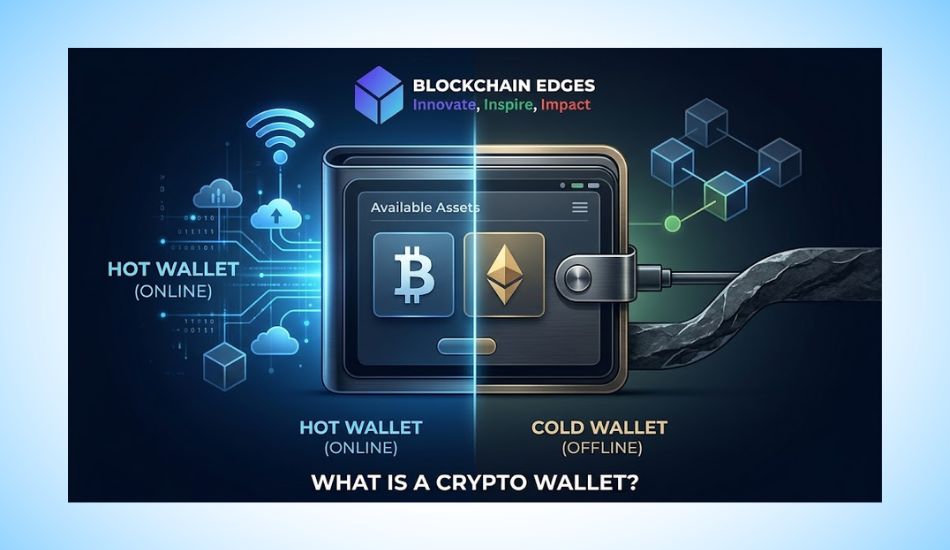
 What is a crypto wallet? If you keep your crypto on an exchange, you may wonder whether you should move it to a wallet you control.
You may also see terms like hot wallet, cold wallet, hardware wallet, custodial wallet, and self-custody wallet and wonder what they really mean.
A crypto wallet does not hold your Bitcoin, Ethereum, or other crypto like a normal wallet holds cash. Your assets remain recorded on the blockchain.
The wallet manages the private keys that let you access and approve transactions. Your wallet address can receive crypto, while your private key must stay secret.
In this guide, you will see the difference between a hot wallet and a cold wallet, how custodial and non-custodial wallets work, and why a seed phrase or recovery phrase matters.
You will also learn when a software wallet such as MetaMask, Trust Wallet, or Coinbase Wallet may make sense, and when a hardware wallet from Ledger, Trezor, or Tangem may be a better fit.
The goal is simple to help you choose a crypto wallet based on how you use your crypto, how much security you need, and how much control you want, without drowning you in technical terms.
What Is a Crypto Wallet and How Does It Work?
A crypto wallet is a tool that helps you access and manage your cryptocurrency. You can use it to send, receive, and manage crypto such as Bitcoin, Ethereum, and other digital assets.
But your crypto is not stored inside the wallet. Your ownership is recorded on the blockchain. The wallet stores and manages the keys that let you use those assets.
Think of your wallet as a key holder:
- Wallet address: You share this to receive crypto.
- Private key: This proves you can control the crypto linked to your address.
- Seed phrase or recovery phrase: This can help restore access to a wallet if you lose your device.
- Blockchain: This records your crypto transactions and balances.
For example, if someone sends you Bitcoin, the Bitcoin moves on the Bitcoin network. Your wallet does not physically receive coins. Your wallet lets you check the balance and approve transactions using your keys.
This is why private key security matters. If someone gets your private key or recovery phrase, they may be able to control your crypto. If you lose your recovery phrase, you may also lose access to a self-custody wallet.
That leads to the next important question: should you use a hot wallet or a cold wallet?
Hot Wallet vs. Cold Wallet: What Is the Difference?
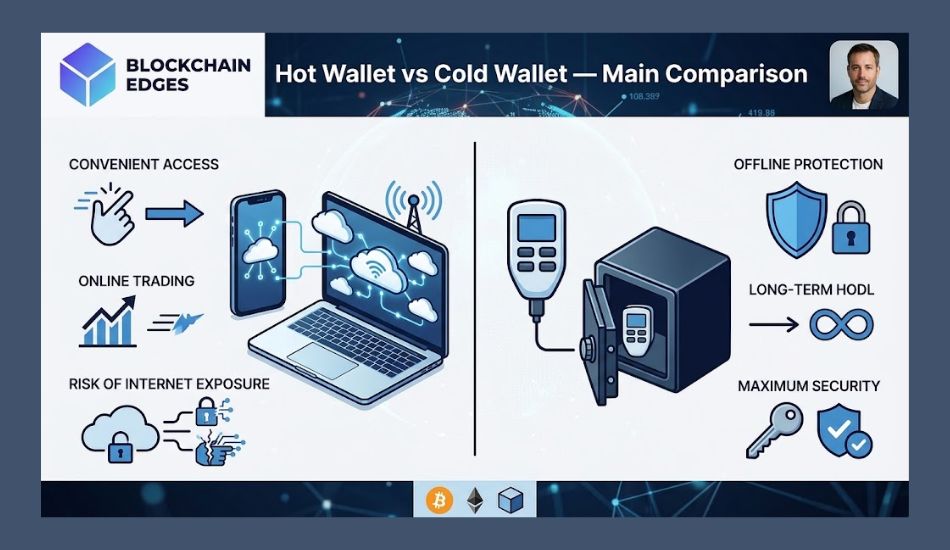
The main difference is whether your wallet stays connected to the internet.
A hot wallet is connected to the internet. A cold wallet keeps your private keys offline when the wallet is not being used. Both can help you manage crypto, but they suit different needs.
| Feature | Hot Wallet | Cold Wallet |
| Internet connection | Usually connected | Usually kept offline |
| Common type | Software wallet | Hardware wallet |
| Easy to use | Yes | Yes, but may take more setup |
| Good for | Regular transactions | Long-term storage |
| Main risk | Online attacks, phishing, malware | Losing the device or recovery phrase |
| Examples | MetaMask, Trust Wallet | Ledger, Trezor, Tangem |
When should you use a hot wallet?
A hot wallet can be useful when you move crypto often. You can access it from your phone, browser, or computer and approve transactions quickly.
For example, you may use a hot wallet to interact with DeFi (Decentralized Finance) apps, non-fungible token (NFT) platforms, or blockchain services. The easy access is useful, but you must be careful with fake websites, phishing links, and malicious apps.
When should you use a cold wallet?
A cold wallet can make more sense when you want to hold crypto for a longer time and do not need to move it often.
A hardware wallet keeps your private keys in a dedicated device. This can reduce exposure to some online threats. However, it does not remove every risk. You still need to protect your PIN, device, and recovery phrase.
Which one is safer?
For many long-term holders, a cold wallet can offer stronger protection against online attacks than keeping funds in a hot wallet. But the safest choice also depends on how you use your crypto and how well you protect your recovery details.
You do not always have to choose just one. You can keep a smaller amount in a hot wallet for regular use and use a cold wallet for longer-term holdings.
Hot vs. Cold Wallet: What Are the Main Risks?
Both wallet types have risks. The main difference is where those risks come from.
| Risk | Hot Wallet | Cold Wallet |
| Internet attacks | Higher exposure because the wallet is connected to the internet | Lower exposure when keys stay offline |
| Phishing | Higher risk when connecting to websites or signing transactions | Still possible if you connect the device or approve a scam transaction |
| Malware | Malware on your phone or computer can be a concern | Private keys are designed to stay on the device |
| Lost device | You may restore the wallet with your recovery phrase | You may restore the wallet with your recovery phrase |
| Lost recovery phrase | You may lose access to the wallet | You may lose access to the wallet |
| Fake apps or websites | Major risk | Still a risk when downloading software or using wallet services |
| Physical theft | Usually less important | The physical device can be stolen |
| Ease of use | Very convenient | Slightly more steps |
| Best suited for | Smaller amounts and regular use | Long-term holdings and larger amounts |
Which wallet has more risk?
A hot wallet generally has more exposure to online threats because it is connected to the internet.
A cold wallet reduces some online risks, but it creates other responsibilities. You still need to protect the device and recovery phrase and verify every transaction.
So, do not think of cold storage as a magic safety button. Think of it as one layer of your crypto security plan.
For many beginners, a practical approach is to use a hot wallet for everyday activity and consider cold storage for crypto you plan to hold for the long term.
What Does a Cold Wallet Actually Protect?
A cold wallet mainly protects your private keys from being exposed to online threats.
When you keep the keys offline, an attacker who compromises your phone or computer may have a harder time accessing those keys directly. This is one reason cold storage is often used for long-term crypto holdings.
What a cold wallet can help protect against
- Some online attacks: Your private keys are kept offline when the device is not being used.
- Certain malware threats: Malware on your computer may have less direct access to keys stored on the hardware device.
- Some remote attacks: An attacker cannot simply access an offline device in the same way they might target an internet-connected wallet.
What a cold wallet does NOT protect you from
A cold wallet cannot stop you from making a bad decision.
You can still lose crypto if you:
- Give someone your recovery phrase.
- Enter your recovery phrase on a fake website.
- Approve a transaction you do not understand.
- Send crypto to the wrong address or network.
- Lose your recovery phrase.
- Buy or use a fake or tampered device.
So, a cold wallet is not a complete security solution. It protects your keys in specific ways, but you still control the final security decisions.
Simple takeaway: cold storage can reduce online exposure, but your recovery phrase and transaction checks remain critical.
Custodial vs. Non-Custodial Wallet: Who Controls Your Crypto?
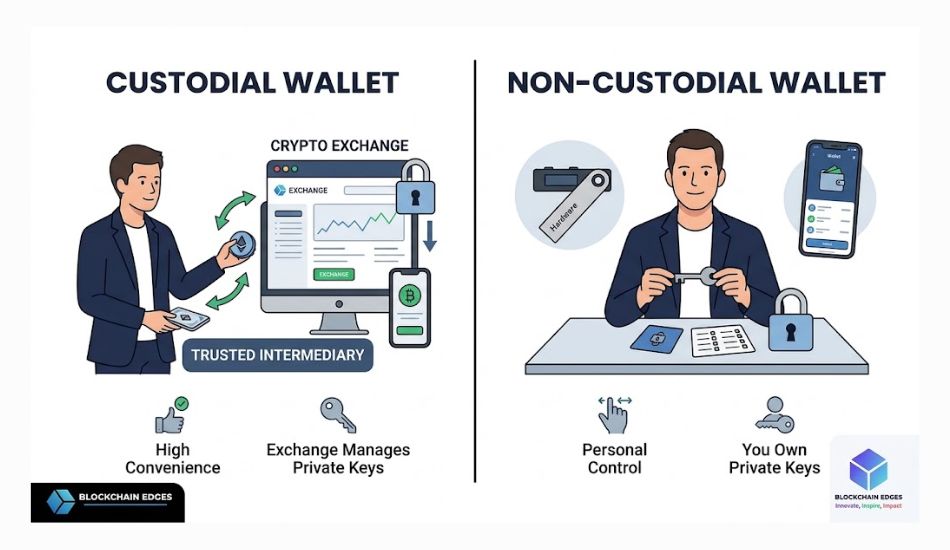
Choosing a crypto wallet is not only about hot vs. cold. You also need to know who controls the private keys.
| Feature | Custodial Wallet | Non-Custodial Wallet |
| Who controls the keys? | A company or exchange | You |
| Who controls the crypto? | You depend on the service | You have direct control |
| Recovery phrase | Usually managed by the service | You must protect it |
| Ease of use | Easier for beginners | Requires more responsibility |
| Main risk | Account or service problems | Losing your keys or recovery phrase |
| Security responsibility | Mostly the service | Mostly you |
| Common example | Crypto exchange account | MetaMask, Trust Wallet, hardware wallets |
| Best for | Users who want convenience | Users who want self-custody |
What is a custodial wallet?
With a custodial wallet, a company or crypto exchange holds the private keys for you.
This can be simple because you do not have to manage a recovery phrase yourself. However, you depend on that company to protect your funds and maintain access to your account.
What is a non-custodial wallet?
With a non-custodial wallet, you control the private keys.
You are responsible for your seed phrase, private keys, and wallet security. This gives you more control, but it also means you must protect your recovery information.
If someone gets your recovery phrase, they may be able to access your crypto. If you lose it, you may not be able to recover your wallet.
Which one should you choose?
Choose custodial storage if convenience is your main concern and you are comfortable trusting a service.
Choose non-custodial storage if you want more direct control over your crypto and are ready to manage your own security.
For many users, the right setup can be a mix: keep a smaller amount available for regular use and consider stronger self-custody for crypto you plan to hold longer.
What Is a Hardware Wallet, and Is It Safer?
A hardware wallet is a small physical device made to protect your crypto wallet keys. Unlike a typical software wallet, your private keys are kept on the device rather than stored directly on your phone or computer.
Popular hardware wallet brands include Ledger, Trezor, and Tangem.
When you want to send crypto, you connect the device and approve the transaction. This adds a physical step before a transaction can be completed.
Why do people use hardware wallets?
A hardware wallet can help reduce the risk from some online threats, such as malware and certain phishing attacks. This makes it a popular choice for people who plan to hold crypto for a long time.
But a hardware wallet is not risk-free.
You still need to protect your:
- Recovery phrase
- Wallet PIN
- Physical device
- Transaction approvals
Never share your recovery phrase with anyone. A real wallet company will not need you to send your recovery phrase through email, chat, or a website.
Is a hardware wallet the safest crypto wallet?
There is no single wallet that is safest for every person.
If you hold a small amount and make frequent transactions, a trusted hot wallet may be more convenient. If you hold a larger amount for the long term, a cold hardware wallet can give you stronger protection from many online risks.
The key is not only which wallet you buy. How you set it up and protect your recovery phrase matters just as much.
What Are a Private Key and Recovery Phrase?
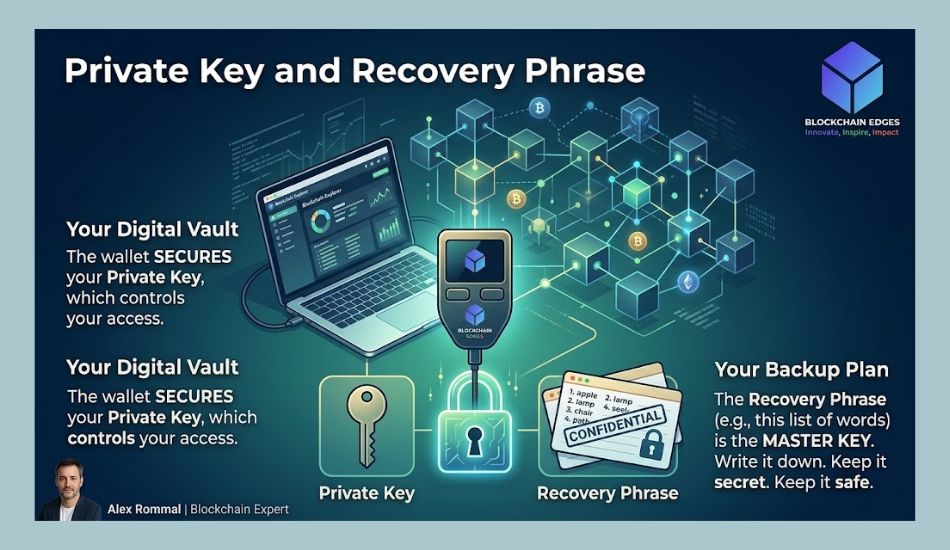
Your private key is what gives you control over crypto held by your wallet. You should treat it like a secret password that must never be shared.
A recovery phrase, also called a seed phrase, is a group of words that can help you restore your wallet if you lose your phone, computer, or hardware wallet.
For example, if your hardware wallet breaks, you may be able to restore your wallet on a new compatible device using the correct recovery phrase.
Why is your recovery phrase so important?
Anyone who gets your recovery phrase may be able to access your crypto. You should never send it to another person or enter it into a website because someone told you to do so.
Keep your recovery phrase offline and private. Avoid saving it in screenshots, email, cloud storage, or chat messages.
You should also be careful when creating a new wallet. Download wallet software only from the official source, check the website address, and never approve a transaction you do not understand.
What if you lose your recovery phrase?
This is one of the biggest risks of self-custody.
A wallet provider may not be able to reset your access like a bank can reset an online banking password. If you lose your recovery phrase and lose access to your wallet, recovering your crypto may not be possible.
That is why wallet security is not only about choosing hot or cold storage. You also need a safe plan for protecting your recovery information.
Which Crypto Wallet Should You Use in 2026?
The right crypto wallet depends on what you plan to do with your crypto. You do not need the same setup for daily transactions and long-term holding.
| Your Situation | Wallet Type to Consider | Why |
| You make frequent transactions | Hot wallet | Quick and easy access |
| You use DeFi or Web3 apps | Hot wallet | Connects easily to many apps |
| You hold crypto for a short time | Hot wallet | Convenient for regular use |
| You hold crypto for the long term | Cold wallet | Keeps keys offline |
| You hold a larger amount | Hardware wallet | Adds another layer of protection |
| You want full control | Non-custodial wallet | You control the private keys |
| You prefer convenience | Custodial wallet | The service manages key security |
What is a good setup for beginners?
You can use more than one wallet.
For example, you could keep a small amount in a hot wallet for everyday transactions while keeping long-term holdings in a cold hardware wallet.
This can reduce the amount of crypto exposed to an internet-connected wallet.
Whatever setup you choose, start small. Learn how sending and receiving crypto works before moving a large amount. Always check the wallet address, network, and transaction details before you confirm a transfer.
Your wallet choice should match your needs, not the wallet with the biggest name or the most features.
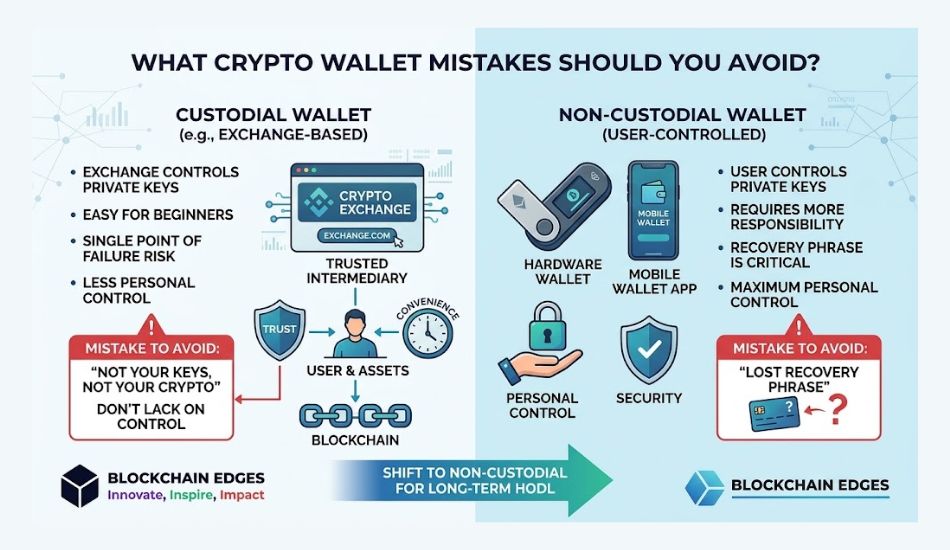
What Crypto Wallet Mistakes Should You Avoid?
Choosing a good wallet is only part of keeping your crypto safe. Your own actions also matter. A few simple mistakes can put your funds at risk.
1. Sharing your recovery phrase
Never share your seed phrase or recovery phrase with anyone. A person who gets it may be able to access your wallet.
2. Saving your recovery phrase online
Do not keep your recovery phrase in screenshots, email, cloud storage, or online notes. Keep it somewhere private and secure offline.
3. Sending crypto to the wrong address
Crypto transfers can be difficult or impossible to reverse. Always check the wallet address and network before you send.
4. Clicking fake wallet links
Scammers can create websites and apps that look like real wallet services. Use the official website or app store listing and check the web address carefully.
5. Approving unknown transactions
A website may ask you to connect your wallet or approve a transaction. If you do not understand what you are approving, stop and check it first.
6. Keeping everything in one wallet
Using one wallet for every purpose can increase your risk. You may choose a separate wallet for regular Web3 activity and another wallet for long-term holdings.
7. Buying a hardware wallet from an unknown seller
If you decide to use a hardware wallet, buy it from the manufacturer or an authorized seller. Check the device and setup instructions before using it.
The simple rule: your crypto wallet is only as safe as the way you use and protect it. Take your time, verify every transaction, and never give anyone your recovery phrase.
What About Keeping Crypto on an Exchange?
A crypto exchange is convenient, but an exchange account is not the same as having full self-custody.
When you leave crypto on an exchange, the platform may control the private keys. Your account can also be affected by account hacks, phishing, withdrawal freezes, or problems at the exchange.
If you keep crypto on an exchange, protect your account with:
- Two-factor authentication (2FA)
- A strong, unique password
- Withdrawal and security alerts
- An email account with strong security
- Careful checks of login pages and withdrawal addresses
For larger or long-term holdings, you can also learn about self-custody and cold storage. But do not move funds to a wallet just because someone tells you to. First, learn how the wallet works and how you will protect its recovery phrase.
Note: moving crypto away from an exchange changes who is responsible for security. With self-custody, you gain more control, but you also take on more responsibility.
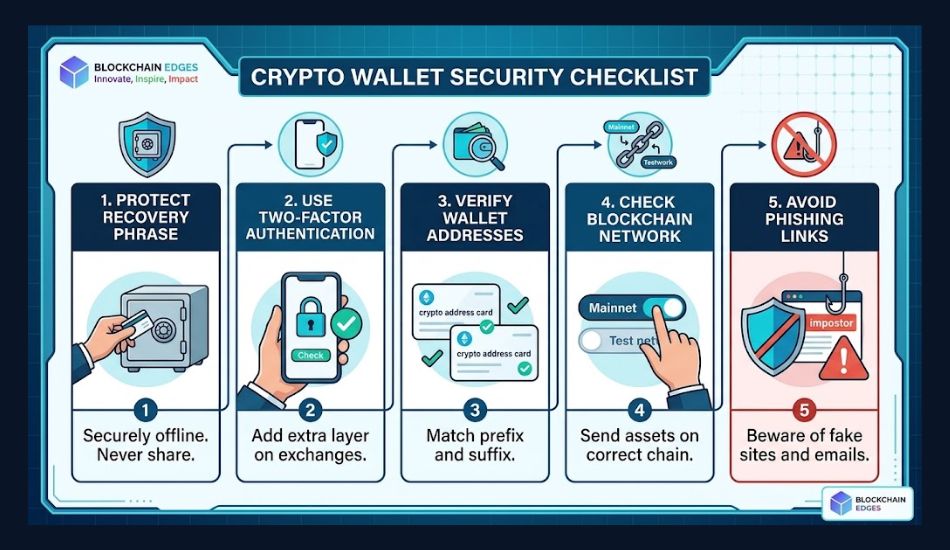
Crypto Exchange Safety Checklist
If you keep crypto on an exchange, use this quick checklist to reduce common account risks.
| Security Check | What You Should Do |
| Use 2FA | Turn on two-factor authentication. An authenticator app is generally better than relying only on SMS. |
| Create a unique password | Use a long password that you do not use anywhere else. |
| Secure your email | Protect the email linked to your exchange account with a strong password and 2FA. |
| Check login pages | Do not log in through links sent by strangers or unexpected messages. |
| Enable alerts | Turn on notifications for logins, withdrawals, and other important account changes. |
| Check withdrawal details | Verify the wallet address and blockchain network before confirming a transfer. |
| Ignore urgent messages | A message telling you to “act now” or send crypto to protect your account is a major warning sign. |
| Review account activity | Check recent logins and transactions. Report anything you do not recognize. |
Before you leave crypto on an exchange
Ask yourself three simple questions:
- Do I need quick access to this crypto?
- Am I comfortable trusting the exchange with custody?
- Would I be able to handle self-custody safely?
An exchange can be useful for buying, selling, and regular trading. For long-term holdings, you may want to learn about non-custodial wallets and cold storage before deciding where to keep your funds.
Never move crypto because someone contacts you and tells you to. Verify the reason, destination address, and network yourself before approving any transfer.
Which Crypto Wallets Can You Consider in 2026?
You do not need the most expensive wallet or the one with the most features. Start with a wallet that matches how you use crypto.
| Wallet | Type | Best For | Key Point |
| MetaMask | Hot, non-custodial | Ethereum and Web3 apps | Easy access to many Web3 services |
| Trust Wallet | Hot, non-custodial | Beginners using multiple networks | Supports many crypto assets |
| Coinbase Wallet | Hot, non-custodial | Beginners who want a separate wallet | Different from keeping funds on Coinbase exchange |
| Ledger | Cold, hardware | Long-term holders | Keeps wallet keys on a physical device |
| Trezor | Cold, hardware | Self-custody users | Hardware-based key protection |
| Tangem | Cold, hardware/card-based | Simple cold storage | Uses physical cards for wallet access |
Which one should you pick?
If you mainly use Web3 apps or make regular transactions, a hot wallet may be more convenient.
If you plan to hold crypto for a long time, a hardware wallet may be worth considering.
If you are new to self-custody, do not rush to move a large amount of crypto. First learn how your chosen wallet works, make sure you understand the recovery process, and test a small transaction.
Also remember that wallet support can vary by coin, blockchain network, country, and wallet version. Always check the wallet provider’s current support information before sending funds.
How Do You Use a Crypto Wallet?
Once your wallet is set up, you mainly use it to receive, send, and manage crypto. The process is simple, but you need to check each step carefully.
To receive crypto
- Open your wallet.
- Choose the cryptocurrency you want to receive.
- Copy your wallet address or show the QR code.
- Give that address to the person sending the crypto.
- Wait for the transaction to be confirmed on the blockchain.
To send crypto
- Open your wallet and choose the crypto you want to send.
- Enter the recipient’s wallet address.
- Select the correct blockchain network.
- Enter the amount.
- Check the address, network, amount, and transaction fee.
- Confirm the transaction.
Always check the network before sending. For example, sending an asset through the wrong network can cause serious problems or make the funds difficult to recover.
You should also send a small test amount when using a new address or wallet for the first time. Once you confirm that it arrived correctly, you can send the rest.
The most important habit is simple: slow down before you press Confirm. A few seconds of checking can prevent a costly mistake.
What Is the Safest Crypto Wallet in 2026?
There is no single crypto wallet that is safest for every user. Your risk depends on how you use your crypto, where you keep your private keys, and how well you protect your recovery phrase.
For long-term holdings, a reputable hardware wallet can reduce exposure to many online threats because your private keys can remain offline. For regular payments and Web3 activity, a hot wallet can be easier to use.
Your security also depends on your own habits.
A safer setup can look like this:
- Keep only the amount you need for regular use in a hot wallet.
- Consider a cold hardware wallet for long-term holdings.
- Keep your recovery phrase offline and private.
- Turn on strong security features where available.
- Check every wallet address and network before sending.
- Never approve a transaction you do not understand.
- Keep your wallet software and device firmware updated through official sources.
You should also avoid choosing a wallet only because it is popular. Check whether it supports the cryptocurrency and blockchain network you plan to use.
The best wallet for you is the one that gives you the right balance of security, control, and ease of use, and that you can manage safely.
How Should You Choose a Crypto Wallet?
You do not need to choose a wallet because it is popular. Choose one that fits your crypto, your habits, and your security needs.
Before you create a wallet, check these five things.
1. Check which crypto it supports
Make sure the wallet supports the coins and blockchain networks you use. A wallet may support Bitcoin but not support every token or network you need.
2. Decide who should control the keys
If you want convenience, you may prefer custodial storage. If you want direct control, look for a non-custodial wallet where you manage your own keys.
3. Match the wallet to your use
For frequent transactions, a hot wallet can be easier. For long-term holdings, a cold hardware wallet may offer better protection from many online threats.
4. Check the security features
Look for features such as PIN protection, transaction confirmation, recovery options, and clear security alerts. Read how the wallet protects your private keys before you deposit funds.
5. Check the recovery process first
Do not wait until something goes wrong to learn how recovery works. Before adding a large amount, make sure you understand how your seed phrase or recovery phrase restores access.
Start small when you are learning. Test receiving and sending a small amount first. Once you understand the process, you can decide whether the wallet is right for your needs.
Which Crypto Wallet Is Right for You?
Your best choice depends on how you use your crypto. Start with your main goal instead of the wallet brand.
| If You… | Consider | Why |
| Buy crypto and make regular transfers | Hot wallet | Quick access |
| Use DeFi or Web3 apps often | Hot wallet | Easy to connect to apps |
| Hold crypto for months or years | Cold wallet | Less online exposure |
| Hold a large amount | Hardware wallet | Adds offline key protection |
| Want someone else to manage the keys | Custodial wallet | Easier account management |
| Want full control of your keys | Non-custodial wallet | You manage your own crypto access |
| Are new to self-custody | Start small | Lets you learn before moving more funds |
Can you use both hot and cold wallets?
Yes. You do not have to choose only one.
You could use a hot wallet for everyday activity and a cold wallet for long-term holdings. This separates your spending or Web3 funds from the crypto you plan to keep for a longer period.
The important part is knowing which wallet holds which funds and keeping your recovery information secure.
If you are moving crypto from an exchange to a wallet for the first time, test with a small amount first. Check that it arrives correctly before sending a larger amount.
Your goal is simple: use convenience where you need it and stronger protection where you need it most.
What Happens If You Lose Your Crypto Wallet?
Losing your phone or hardware wallet does not always mean you lose your crypto.
Your crypto remains recorded on the blockchain. What matters is whether you can still recover access to your wallet.
If you use a non-custodial wallet, your recovery phrase is usually the key to restoring access. You can use the correct recovery phrase with a compatible wallet to restore the same wallet and its assets.
For example, if you lose your phone but keep your recovery phrase safe, you may be able to install the wallet on a new device and restore access.
What if your hardware wallet breaks?
A broken or lost hardware wallet does not automatically destroy your crypto. If you have your correct recovery phrase stored safely, you can normally restore the wallet on a compatible replacement device.
What if you lose the recovery phrase?
This is much more serious.
With self-custody, there may be no company that can reset your wallet password or recover your funds for you. Losing your recovery phrase can mean losing access to your crypto.
Never store your recovery phrase with the wallet device itself. Keep a secure backup in a private place where you can access it if the original device is lost or damaged.
The simple rule is: protect your recovery phrase as carefully as you protect your crypto.
Key Takeaway: Which Crypto Wallet Should You Choose?
A crypto wallet gives you a way to manage access to your digital assets. The main choice is not simply between one wallet brand and another. You need to decide how much convenience, control, and security you need.
A hot wallet can work well for smaller amounts and regular transactions. A cold wallet can make more sense for crypto you plan to hold for the long term.
A custodial wallet is easier to manage, while a non-custodial wallet gives you more control over your private keys.
If you are new to crypto, start small. Learn how your wallet works, protect your recovery phrase, and check every transaction before you approve it.
The safest wallet is not simply the one you buy. It is the wallet you understand and use carefully.
Helpful article: What Is Cryptocurrency? How Digital Money Actually Works
FAQs: How Can You Protect Your Crypto Wallet From Scams?
1. Do you need a crypto wallet to buy Bitcoin?
No. You can buy and hold Bitcoin through a crypto exchange. A wallet becomes important when you want more control over your crypto or want to use blockchain apps directly.
2. Does a crypto wallet store your crypto?
No. Your crypto is recorded on the blockchain. Your wallet manages the private keys that give you access to your crypto.
3. Is a hot wallet safer than a cold wallet?
Not usually for long-term storage. A hot wallet is connected to the internet, so it has more exposure to online threats. A cold wallet keeps your keys offline and can reduce some of these risks.
4. Can a cold wallet be hacked?
A cold wallet can still be involved in scams or security problems. For example, you could approve a harmful transaction or expose your recovery phrase. Keeping the device offline reduces some risks, but it does not make you completely safe.
5. What happens if you lose your crypto wallet?
If you use a non-custodial wallet and still have your correct recovery phrase, you may be able to restore access using a compatible wallet or device. Without the recovery information, recovery may not be possible.
6. Is a hardware wallet worth it?
It can be worth considering if you plan to hold crypto for a long time or want to reduce exposure to online threats. You should still learn how to use and protect the device before moving a large amount.
7. Should you keep all your crypto on an exchange?
An exchange can be convenient for buying, selling, and trading. But keeping crypto there means you depend on the exchange for custody and account access. If you want direct control, you can learn about non-custodial wallets and self-custody.
Hot Wallet vs. Cold Wallet: Quick Answer
A hot wallet stays connected to the internet and is usually better for frequent crypto use, such as sending funds or using Web3 apps.
A cold wallet keeps your private keys offline when not in use. It is often better suited to long-term crypto holdings because it reduces exposure to many online threats.
- If you need convenience: consider a hot wallet.
- If you want stronger offline protection: consider a cold wallet.
- And if you want full control: consider a non-custodial wallet.
You can also use both. Keep a smaller amount in a hot wallet for everyday use and consider cold storage for long-term holdings.

1 Comment
Is Cryptocurrency Safe in 2027? Honest Guide for Beginners
October 3, 2026[…] you use a personal crypto wallet, keep your recovery phrase offline and private. Never share it with anyone, even someone claiming […]