



 Alex Rommal
 What is cryptocurrency? It means digital money that lets you send, receive, or hold value online without relying on a bank to record every transaction. If you have heard names like Bitcoin and Ethereum but still wonder whether crypto is real money, you are not alone.
The confusing part is that cryptocurrency does not work like the dollars in your bank account. Instead, transactions are recorded on a blockchain, a shared digital ledger maintained across a network of computers.
This is the basic idea behind blockchain, explained in simple terms: instead of one company keeping the main record, a network helps maintain and verify it.
You’ve heard the word everywhere. Your cousin won’t stop talking about Bitcoin. The news mentions Ethereum crashing or soaring. Some app on your phone is asking if you want to “buy crypto” with your spare change.
You’ve probably nodded along while quietly wondering: what is this actually? Is it real money? Is it a scam? Is it something only tech people understand?
You’re not behind. Most people using the word “crypto” every day couldn’t explain how it actually works if you asked them directly. This guide fixes that: no jargon, no assumptions, just a clear walkthrough of what cryptocurrency is, how it works, and why it exists in the first place.
So, how does cryptocurrency work when there is no traditional bank in the middle? Your digital wallet lets you manage crypto and interact with the network, while your wallet address helps you send and receive digital assets.
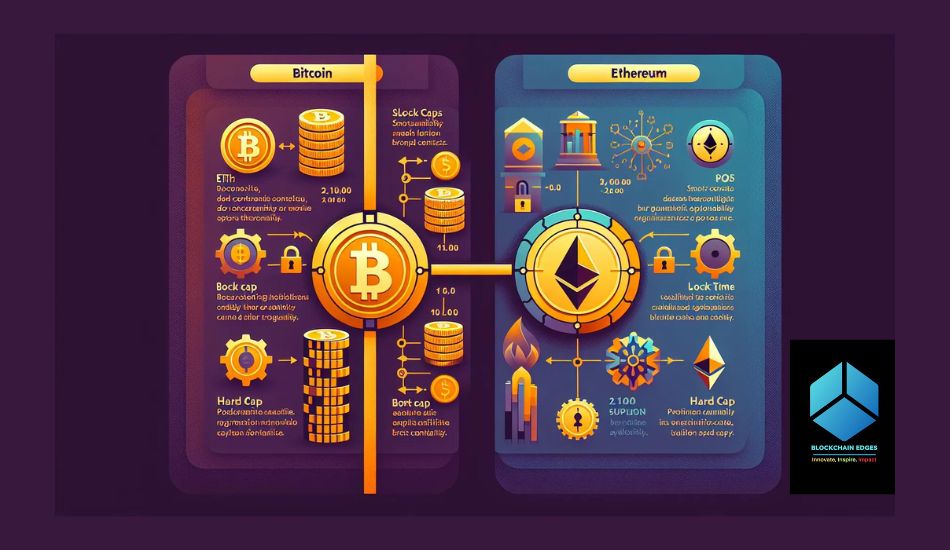
Bitcoin is mainly designed as digital money and operates through a peer-to-peer network, while Ethereum goes further by supporting smart contracts and applications. That is why understanding Bitcoin vs Ethereum is important when you are learning how crypto works.

The Simple Definition First: What Is Cryptocurrency in Simple Words?
Cryptocurrency is digital money that no bank or government controls. It exists only as computer code, and it’s secured by a technology called cryptography, the same branch of math used to protect passwords and secure messages. That’s actually where the name comes from: crypto (cryptography) plus currency (money).
Think of a blockchain as a public record book. When you send cryptocurrency, the network checks the transaction and records it on the blockchain. Once the transaction is confirmed, the record can be difficult to change. This helps the network keep track of who sent value, who received it, and how much was transferred.
For example, Bitcoin was created as a peer-to-peer form of digital money. You can send Bitcoin to another person without needing a traditional bank to process the transfer. The Bitcoin network uses computers around the world to verify and record transactions.

What is Ethereum (ETH)? How does it work?
Ethereum works differently. It also has a cryptocurrency called Ether (ETH), but the Ethereum network can do more than transfer value. It supports smart contracts, which are programs that can run on the blockchain when their rules are met. This is one of the key differences you will see when comparing Bitcoin vs Ethereum.
To use cryptocurrency, you normally interact with a digital wallet. Your wallet helps you manage your crypto and send or receive assets on a blockchain network. It does not work like a physical wallet filled with coins. Instead, it helps you manage the information needed to access and control your digital assets.
Instead of a bank keeping track of who owns what in a private database, cryptocurrency uses a public, shared record that thousands of computers around the world maintain together. That record is called a blockchain, and it’s the piece that makes everything else possible.
So, in simple terms, cryptocurrency combines digital value, blockchain technology, cryptography, and decentralized networks. The goal is to let people transfer and manage value digitally without depending on a single central authority for every transaction.
Why Does Cryptocurrency Even Exist?
To understand crypto, it helps to understand the problem it was trying to solve.
Normally, when you send money digitally through a bank transfer or an app like PayPal, you’re trusting a middleman. The bank verifies the transaction, updates its records, and takes a cut for the service.
That works fine most of the time, but it comes with tradeoffs: banks can freeze accounts, transfers can take days, fees pile up, and in some countries, huge numbers of people don’t have access to a bank account at all.
In 2008, someone (or a group of people) using the name Satoshi Nakamoto published a paper describing a different idea: money that could move directly between two people, with no bank in the middle, verified instead by a network of computers following shared rules. In 2009, that idea became Bitcoin, the first cryptocurrency.
The goal wasn’t just “internet money.” It was money nobody could control, freeze, or print more of at will.

How Does Cryptocurrency Actually Work?
You will move from confusion to a clear understanding of cryptocurrency. You will learn what Bitcoin and Ethereum actually do, how blockchain records transactions, what a digital wallet really holds, and why people use cryptocurrency in the first place. However, you should be able to explain crypto in simple words, not as mysterious internet money, but as a new way of creating, transferring, and managing digital value. Here’s the part that trips most people up, broken into pieces you can actually picture.
1. The Blockchain Is a Shared Notebook
Imagine a notebook that records every transaction ever made: who sent what to whom. Now imagine that instead of one bank holding that notebook, thousands of copies exist on computers all over the world, and they all have to agree before a new entry is added.
That’s a blockchain: a chain of “blocks,” where each block is a batch of transactions, linked to the one before it. Once a block is added, changing it would mean changing every copy on every computer at once, which is effectively impossible. That’s what makes the record trustworthy without needing a bank to vouch for it.
2. Miners and Validators Keep It Honest
Someone has to check that transactions are legitimate and that you’re not spending money you don’t have. This job belongs to miners (in Bitcoin’s system) or validators (in newer systems like Ethereum’s).
- Mining (Proof of Work): Computers compete to solve a complex math puzzle. Whoever solves it first gets to add the next block and earns a reward in cryptocurrency. This is Bitcoin’s method, and it uses significant computing power and electricity.
- Staking (Proof of Stake): Instead of competing with computing power, validators lock up (“stake”) their own cryptocurrency as a deposit. If they approve fraudulent transactions, they lose that stake. Ethereum switched to this model in 2022 because it uses far less energy.
Either way, the outcome is the same: a decentralized group of strangers, who don’t know or trust each other, collectively agree on what’s true.

3. Digital Wallets Are Your Access, Not a Piggy Bank
A common misunderstanding: your crypto isn’t “stored” in your wallet the way cash sits in a piggy bank. Your coins live on the blockchain itself. A digital wallet just holds the keys that prove the coins are yours and let you spend them.
Every wallet has two important pieces:
- A public key (or wallet address): safe to share, like a bank account number. People use this to send you crypto.
- A private key: a secret code that proves ownership and lets you spend or transfer funds. Anyone with your private key can access your funds, which is why losing it or having it stolen is one of the biggest risks in crypto.
Wallets come in two main types:
- Hot wallets (apps or exchange accounts connected to the internet, convenient but more exposed)
- Cold wallets (offline devices, safer for holding larger amounts long-term).
Bitcoin vs. Ethereum: What’s the Real Difference?
These two get lumped together constantly, but they were built for different purposes.
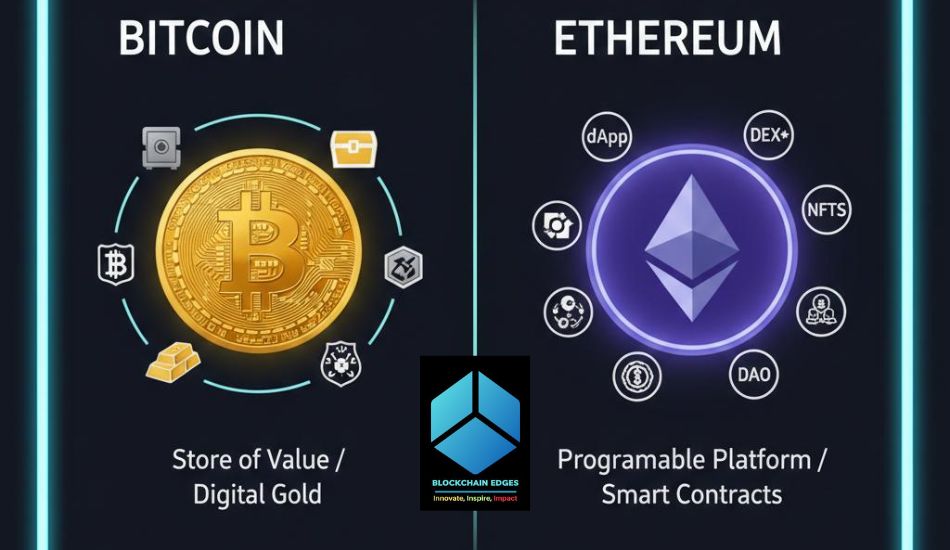
Bitcoin was designed primarily as digital money, a way to store and transfer value without a bank. Its supply is capped at 21 million coins, which is a core part of its appeal: it can’t be inflated by printing more, the way government currencies can.
Ethereum was built to do more than move money. It introduced smart contracts, self-executing pieces of code that automatically carry out an agreement when conditions are met, no middleman required.
This is the foundation for things like decentralized apps, NFTs, and automated financial tools (DeFi) that run without a bank or company managing them.
A simple way to think about Bitcoin is closer to digital gold. Ethereum is closer to a global, programmable computer that anyone can build on.
| Feature | Bitcoin (BTC) | Ethereum (ETH) |
| Main purpose | Designed mainly as digital money and a way to transfer value | Designed as a blockchain platform for digital applications and programmable transactions |
| Launched | 2009 | 2015 |
| Native cryptocurrency | Bitcoin (BTC) | Ether (ETH) |
| Blockchain role | Records Bitcoin transactions and helps move BTC between users | Records ETH transactions and supports smart contracts and decentralized applications |
| Smart contracts | Limited scripting capabilities | A major part of the Ethereum network |
| What makes it useful? | Digital payments, storing value, and transferring BTC | Payments, smart contracts, decentralized applications, and other blockchain-based services |
| Transaction network | Bitcoin network | Ethereum network |
| Simple way to think about it | Digital money | Digital money & programmable blockchain platform |
| Best beginner takeaway | Bitcoin focuses more on digital money and value transfer | Ethereum focuses more on programmable blockchain activity and applications |
Bitcoin was created as a peer-to-peer electronic cash system, while Ethereum was designed as a programmable blockchain that can run smart contracts and decentralized applications. ETH is the native cryptocurrency used on Ethereum.
In simple terms: If you think of Bitcoin as digital money, you can think of Ethereum as a blockchain platform that also has its own digital currency, ETH. That does not mean one is automatically better than the other. They were built with different goals, so your understanding should start with what each network is designed to do.

What Is Cryptocurrency? Is It “Real” Money?
This is the question underneath the question, and it deserves a straight answer. Cryptocurrency has real value in the sense that people are willing to buy, sell, and trade it, and some businesses accept it as payment.
Its value comes from a mix of factors. How useful the network is, how many people trust and adopt it, how limited the supply is, and plain market demand, similar to how gold has value partly because people agree it does.
But it’s also genuinely different from the money in your bank account:
- It’s volatile. Prices can swing dramatically in a single day, far more than typical currencies.
- It’s not government-backed. There’s no central bank guaranteeing its value or insuring your holdings the way deposit insurance protects a bank account.
- It’s not universally accepted. Most everyday purchases still can’t be made directly with crypto.
So it’s real in the sense that it holds and transfers value. It’s not “real” in the sense of being a stable, government-guaranteed currency you can treat like cash in the bank. Treating it as a high-risk asset rather than a savings account is the honest way to think about it.

Conclusion: Why Was Cryptocurrency Created? The Simple Answer for Beginners?
Cryptocurrency isn’t magic internet money, and it isn’t a scam by default either; it’s a genuine technological alternative to how money has traditionally worked, built on a shared public ledger instead of a bank’s private one.
Bitcoin created the concept of decentralized digital money. Ethereum expanded it into a platform for programmable agreements. Wallets and keys are how you access and prove ownership of it all.
You don’t need to trade it, invest in it, or even like it to understand it. But now, the next time someone mentions crypto at dinner, you’ll actually know what they’re talking about.
Relevant article: What Is Blockchain Security? Key Concepts & Best Practices.

FAQs: What Is Cryptocurrency Used For? Real Uses Explained Simply?
1. What Is Cryptocurrency?
Cryptocurrency is a type of digital asset that you can use to transfer value over the internet. Unlike the money in your bank account, it is not controlled by one central bank or stored as physical cash. Instead, many cryptocurrencies use blockchain technology to record transactions on a shared network.
2. What is cryptocurrency in simple words?
Cryptocurrency is digital value that you can send and receive online. It uses blockchain technology to record transactions across a network. Bitcoin is the best-known example, while Ethereum is another major blockchain network with its own cryptocurrency called Ether (ETH).
3. How does cryptocurrency work?
Cryptocurrency works through a blockchain network rather than a traditional bank. When you send crypto, the network checks the transaction and records it on the blockchain. Once confirmed, the transaction becomes part of the network’s shared record. Your digital wallet helps you manage the information needed to send and receive your crypto.
4. Is cryptocurrency real money?
Cryptocurrency is real in the sense that it can have market value and can be transferred between people. However, it is not the same as government-issued money such as the U.S. dollar. Its value can change quickly, and whether you can use it to pay for goods or services depends on the merchant, platform, and local rules.
5. What is a blockchain and why does crypto use it?
A blockchain is a shared digital record of transactions. Instead of one central organization keeping the only copy, a network of computers helps maintain and verify the record. Cryptocurrencies use blockchains to track transactions and help prevent the same digital asset from being spent twice.
6. What is a digital wallet in cryptocurrency?
A digital wallet is a tool that lets you manage cryptocurrency and interact with a blockchain network. It can help you send and receive crypto and manage the information connected to your assets. A crypto wallet does not simply store physical coins because cryptocurrency exists digitally.
7. What is the difference between Bitcoin and Ethereum?
Bitcoin was created primarily as a peer-to-peer digital payment system and a means of transferring value. Ethereum is a programmable blockchain that supports smart contracts and decentralized applications, and its native cryptocurrency is Ether (ETH). In simple terms, Bitcoin focuses more on digital money, while Ethereum provides a wider platform for programmable blockchain activity.
8. Why does cryptocurrency have value?
Cryptocurrency can have value because people are willing to buy, sell, hold, or use it. Different cryptocurrencies can have different reasons for demand. Bitcoin, for example, has a limited supply and is used for transferring and holding value, while ETH is also used to pay for activity on the Ethereum network. Market demand and supply can cause crypto prices to rise or fall.
9. Is cryptocurrency safe for beginners?
Cryptocurrency can be useful, but it comes with risks. Prices can change sharply, transactions may be difficult or impossible to reverse, and losing access to your wallet credentials can create serious problems. If you are new to crypto, learn how wallets, private keys, scams, and blockchain transactions work before sending or buying cryptocurrency.
